
How long does it take to learn English?
It's about acquiring skills and accumulating the time. There is no real shortcut. Learning a language is about hard work and consistency.
Eric Froiland
1/7/20262 min read
Language learning is not a lottery, a talent test, or a matter of luck. It is an hour race. Progress depends on how many focused hours you invest, how well you use those hours, and how consistently you return to the language. The Common European Framework of Reference for Languages (CEFR) helps us understand this process clearly and honestly.
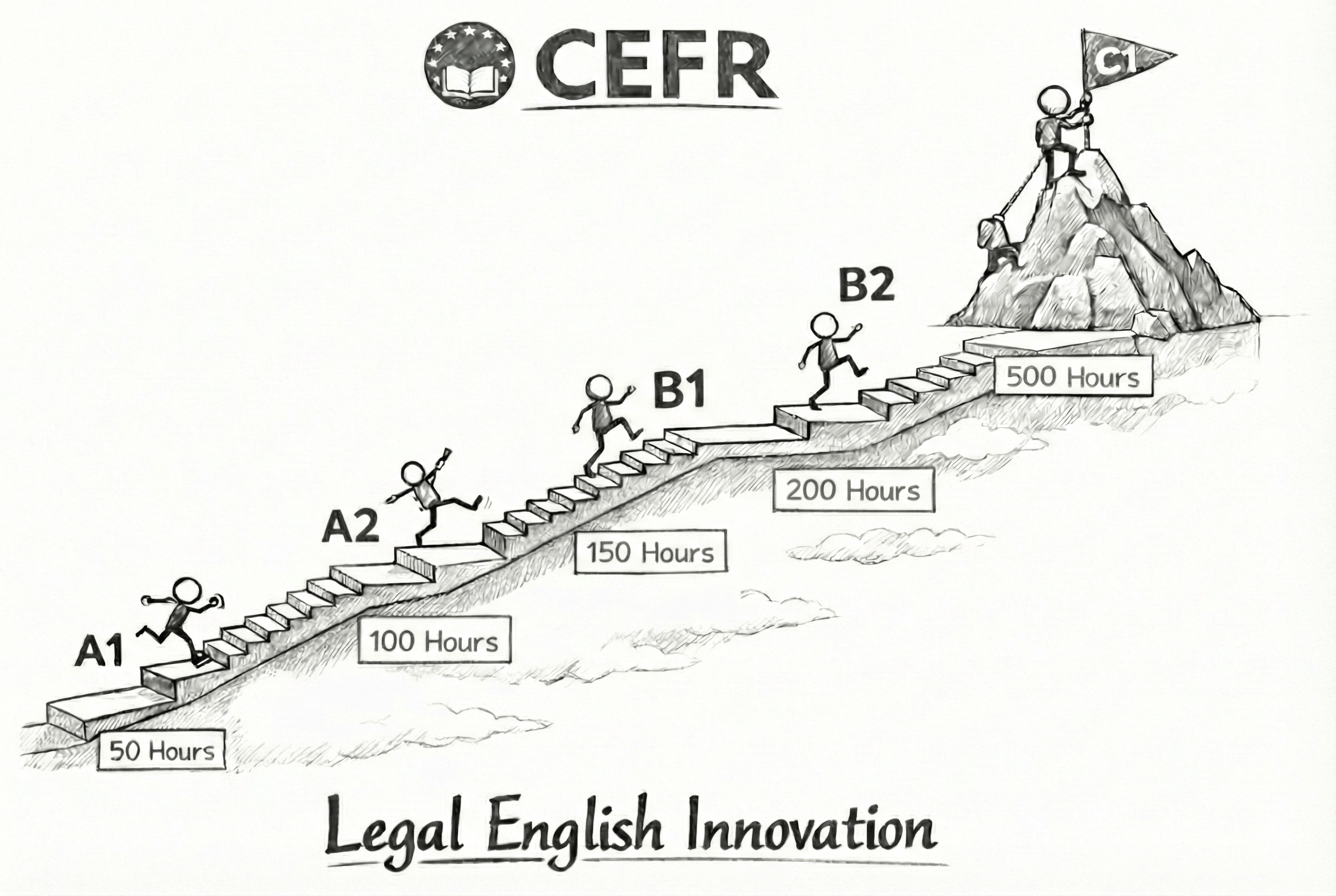
The CEFR is not about speed. It is about accumulation. Every level represents time, practice, reinforcement, and exposure. The diagram above shows this idea visually: learning a language is like moving through a safe obstacle course. You do not jump to the top—you move step by step, hour by hour.
The Reality of Time in Language Learning
Most major language academies around the world recommend an average of two years of structured study, with about five hours per week, to reach an upper-intermediate or advanced level in a foreign language. This adds up to several hundred hours of guided learning. Of course, results depend on many factors: previous language experience, quality of instruction, exposure outside the classroom, motivation, and consistency. Still, time remains the common denominator.
No matter the method, hours matter.
A1: The First 50 Hours – Getting Started
At the A1 level, learners usually complete around 50 hours of study. This stage focuses on survival language: basic vocabulary, simple grammar, introductions, and everyday expressions. You are learning how the language sounds, how sentences are built, and how communication works at a basic level. Progress here is fast, but it still requires repetition and guidance.
A2: 50 to 100 Hours – Building Confidence
A2 expands on that foundation. Between 50 and 100 additional hours, learners begin to understand common situations and express simple ideas more clearly. You can talk about routines, past events, and plans. This is where confidence starts to grow, but gaps are still very visible. Reinforcement is essential.
B1: 100 to 150 Hours – Functional Independence
B1 is a key turning point. With 100 to 150 hours of focused study, learners move from basic communication to functional independence. You can handle work-related conversations, explain opinions, understand the main ideas of texts, and participate more actively. Many learners feel that this is where “real English” begins.
B2: 101 to 150 Hours – Control and Precision
At B2, another 101 to 150 hours are typically required. The language becomes more precise and flexible. You can follow complex discussions, understand abstract ideas, and communicate with fewer misunderstandings. This level demands sustained practice and exposure, not shortcuts.
C1: 250+ Hours – Mastery Through Accumulation
C1 is not a jump—it is a climb. After 250 hours or more beyond B2, learners reach a level where English can be used comfortably in academic, legal, or professional contexts. At this stage, language feels natural, but it is the result of hundreds of accumulated hours, not talent alone.
The Message Behind the Diagram
The diagram tells a simple truth: language learning is a game of hours. Each obstacle represents effort, practice, and progress. There is no luck involved—only time, strategy, and commitment. When students understand this, motivation becomes clearer and goals become realistic.
Language success is built one hour at a time.